Dent-Line of Canada Inc. Toll Free 1-800-896-6544 (for Canada only) 416-858-9865 or Fax No. 416-858-9899

Dent-Line of Canada Inc. Toll Free 1-800-896-6544 (for Canada only) 416-858-9865 or Fax No. 416-858-9899
A BULLETIN DEALING WITH ISSUES FOR DENTAL HEALTH PROFESSIONALS
Inside This Issue
1. An Alternative Approach to Implant Loading
2. Bredent’s Master Pin / Master-Split Model System
3. Landmark Implant Study Published
4. Technorama 2002
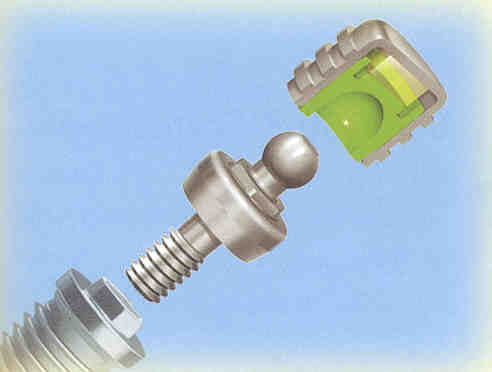 Implant therapy is a standard treatment for the restoration of fully and partially edentulous patients. Implants are subjected to the masticatory process which is influenced by occlusal load, primary or secondary occlusal trauma and tissue reaction due to adverse clinical conditions. The greatest masticatory forces are generated when the maxillary and mandibular occlusal surfaces are in contact. Although the periods of occlusal contact are of very short duration, while chewing the accumulative result on a daily basis can add up as much as 30 minutes of actual contact loading. Bruxers and TMJ suffers can subject the implants to much higher loads. It is this type of abuse that can result in degenerative changes to the periodontal tissue, alveolar bone and muscle attachment. Axial and horizontal loading results in implant movements in all directions. Measurement of these movements has shown that patients with implant borne dentures have a stronger ultimate bite force than those with conventional dentures. Clinically mobility is either reversible or irreversible. The removal of inflammation or negative forces may result in the elimination of mobility. Surgical procedures can be utilised to try and improve the implant longevity but these procedures are both time consuming and have questionable results. The recent introduction of the Bredent Vario-Stud Snap OC-RS Implant Abutments is an alternative retention method, since the plastic retentive inserts are resilient and have a built in “shock absorber”. The Bredent implant stud abutments fit Branemark, Steri-Oss, Replace and 3i external hex platforms. During mastication forces averaging 8 kg of axial loading starts the shock absorber to compress to a depth of 0.5mm. In this way it provides a “buffering” action during the masticatory process to reduce the loading responsible for premature failure of implants. With the availability of the Bredent Implant abutments it is now possible to have an advantage over conventional attachments. Studies show an incidence of implant failure due to surgical trauma, bio-mechanical loading, and misfitting over dentures. The resilient retentive inserts may tentatively provide adequate cushioning there by reducing resorbtion and micro fractures to the implant bone interface. This will provide patients with an alternative retention system that has not been an option until now. The laboratory procedures and fabrication begins after the healing phase has elapsed. A proper abutment is selected and screwed in to place. The impression is made and the dental laboratory is provided with a transfer analogue. After the completion of the master model the denture is waxed for fit and the axle analogues are placed over the transfer analogue studs to check the divergence. This divergence should not exceed 15 degrees on each abutment. The titanium housing and retention sleeve is placed on to the analogues and is held in position with the parallel mandrel to determine the path of insertion. The off set is filled with plaster to ensure the position. The waxed denture is placed on the model and finished to the standards of practice. A pick up technique interorally can also be utilized. The resilient retention sleeves can be exchanged for a higher friction, chair side if need be. Source; Peter T. Pontsa RDT. With special thanks to Dr. Isaac Barzilay for assisting on the clinical aspects.
References; 1. Dr. Angelo Caputo & Dr. Robert Wylie. Force Generation & Reaction Within The Periodontium UCLA Lecture 2000. 2. W. Niedermer, Occlusion & Periodontal Reaction, Zahnheilkunde 1993. 3. Drs. L. Lindquirst, G. Carsson, .T. Jemet, A Prospective 15 Year Follow-Up Study of Mandibular Fixed Prosthesis,Clinical Results. Clinical Oral Implant Research 1996.
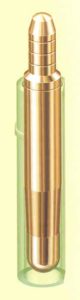 Bredent introduces the Master Pin System designed by Thomas H. Wendler MDT. The system is a brass pin and plastic sleeve which has the smallest drilling depth of all pins of 4.5 mm. The advantage of a short drill hole means no perforation of the arch during drilling. The Master Pin and Sleeve can be easily assembled because of the taper and the rounding of the end of the pin. The overall length of the pin is 11.7 mm, which provides a low profile master model.The unilateral flattening of the Master Pin sleeves prevents rotation in the base stone and can be placed closer together in narrow areas. There is a special surface design of the plastic wall of the sleeve which assures a soft friction while providing maximum precision and stability. Drill holes are prepared, two for each die. Beginning from the buccal direction the first one is in the centre of the fissure and the second drill hole is approximately 2 to 3 mm away toward the lingual direction or palatally. The pin system is complimented by the Master Model System which is used to prepare the base for the arch. It consists of base former and magnetic plate which sits on the bottom. The prepared arch is placed in the model former and the base is filled. Once hard the model can be pressed out and dies cut. The Model System helps to save plaster which has one plate for all three model sizes. There is more retention due to the octagon platform around the integrated magnet. It is reusable, color coded and inexpensive to use. For further information call 1-800-859-7589 or email us at [email protected]
Patients and periodontist are scrambling to learn more about an innovative procedure using dental implants since a landmark study conducted by Drs. Jeffery Ganeles, Marvin M. Rosenburg, Robert L. Holt and Linda M. Reichman RDH was published in the prestigious International Journal of Oral & Maxiofacial Implants. The group based at the Florida Institute for Periodontics and Dental Implants, presented their findings in the May/June issue of the peer reviewed journal. In it they revealed their dramatic conclusions on their technique called Teeth Today™ a procedure that reduces the time required for patients to receive fixed replacement teeth with implants from six months to a mere 24 hours. Statistics reveal that procedures like Teeth Today™ are in high demand. According to the National Institutes of Health, 67 million Americans suffer from periodontal disease, the leading cause of adult tooth loss in the country. At least 113 million Americans are missing one or more teeth. Source; Infodent No. 26/2001.
Publishers’ Note:
On a personal note I find this study quite remarkable and hope that it will be more than just a good story. Both component strength and bone potency are biomechanical aspects that have to be taken into consideration in treatment planning. We will report further updates on this study when more information becomes available.
Peter T. Pontsa, R.D.T.
Dent-line of Canada would like to remind you that Technorama 2002 will be held Friday, March 22nd and Saturday, March 23rd at the International Plaza Conference Centre at 655 Dixon Rd., Toronto, Ontario, M9W 1J4. We will also be sponsoring a one hour seminar called; An Alternative Approach to Loading of Implants and Root Borne Removable Restorations. It will be presented by Peter T. Pontsa RDT and continuing education credits will apply. We encourage you to also visit our booth to see the newest products from bredent and meet the customer service people that do their best to get the products you need for your laboratory.