Dent-Line of Canada Inc. Toll Free 1-800-896-6544 (for Canada only) 416-858-9865 or Fax No. 416-858-9899

Dent-Line of Canada Inc. Toll Free 1-800-896-6544 (for Canada only) 416-858-9865 or Fax No. 416-858-9899
A BULLETIN DEALING WITH ISSUES FOR DENTAL HEALTH PROFESSIONALS
Inside This Issue
1. Alloy Health Issue Concerns
2. Attachment Questions and Answers
3. Todays’s Product: Wax Palatines
4. Research Finds Friendly Bacteria
5. Technorama 2001
With health issues a major concern, it is important to work with materials and manufacturers that have a similar focus. Brealloy C+B 270 manufactured by Bredent Germany was created specifically to eliminate harmful elements that could be detrimental to patients, clinicians and technicians. It is free from sensitive materials such as nickel, beryllium and gallium. Brealloy is a biocompatible, chrome – cobalt – molybdenum alloy suitable for ceramics, crowns, bridges and bar restorations. It can be milled flawlessly on attachment techniques and exhibits optimum precision in one piece casting procedures. Marginal integrity is excellent and it has a Vickers Hardness of 270. Tap and screw techniques can be easily carried out since it has the same ductility and other properties of precious metals. The handling characteristics of this alloy are within standards of practice. This means that there are no changes to laboratory procedures. Recent dental laboratory test results in Canada indicate excellent expansion coefficient for 900 porcelain systems on single and long span bridges. Thanks go to Mr. Andrew Sommers, R.D.T., owner of Classic Dental lab in Woodbridge, Ontario who has tested Brealloy in his laboratory on actual cases. The alloy conforms to DIN 13912 and DIN EN ISO 9693 quality standards.
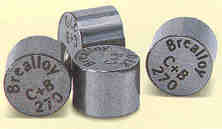
BREALLOY C & B 270
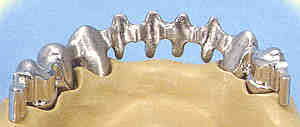
Brealloy C & B 270 is a Co Cr Mo alloy free from nickel, beryllium and gallium. It is ideal for ceramic to metal restorations on single and long span bridges
Two studies on the evaluation of the corrosion stability of non-precious metal alloys have been documented.
(1) J.Geiis-Gersthofer; K.H.Sauer; H. Weber (in vitro corrosion study on the material consumption of non-precious metal alloys 1986).
(2) R. Strietzel; J.Viohl (determination of the invitro corrosion rates of amalgams and dental alloys with the help of atomic abrasion spectroscopy 1986). The Co Cr Mo alloys mentioned in the two text sources above are almost within the range of gold casting alloys. The absence of elements with a highly allergenic potential such as nickel and beryllium in the alloy makes Brealloy a suitable alternative to high priced palladium alloys with similar properties.
To receive a free Brealloy physical value and composition booklet call 1-800-859-7589 or e-mail us at dent-line of canada inc.
I have been using Bredent attachments in my laboratory for the past year or two. Recently I have been experiencing problems. Let me describe two. Maybe you can have a tech person advise me or call me with a suggestion.
Problem 1: A female patient had teeth 6-11 crowned and splinted. Round bredent attachments were placed on the distals of 6 and 11. Conventional female grooves were placed between the canines and lateral incisors with the corresponding male counterpart on the partial denture. After wearing this for approximately one year the retention loosened. When the lab replaced the yellow attachments with red ones the partial no longer seated without a handpiece adjustment to the bredent attachment on the buccal aspect (distal tooth # 11). What happened here? What went wrong? Shouldn’t the partial have reseated in its original position once the new attachments were snapped into place by my laboratory?
Problem 2: Same situation. Splinted crowns from 6-11 with female grooves between the canines and laterals. Round bredent attachments distal to the canines. In this case the metal male attachments that would slide in between the canines and laterals broke off bilaterally. My question to you is not how this happened (although I would be interested in your thoughts). My question is if the partial needs to be redone and cannot be repaired… how do I do this without redoing the accompanying crown and bridgework from 6-11? Is it possible to take an impression and register an accurate transfer of the round male attachments distal to the canines? If so, how could I eliminate any alignment problems? I would appreciate any help you would have to offer. Thank you, Dr. Jay A. Millar, 4249 Route 9 North Freehold N.J. USA.
Answer to problem 1:
Bredent recommends when a yellow female loses its retention it should be replaced with a new yellow female. Red, the highest retention is used when the replacement yellow cannot provide it. As for the poor reseating there a few possibilities. The red females were not properly seated in the housing because the original yellow was previously adjusted to fit. Also after a year in the mouth it is normal for a partial to need a reline at the time of the retention replacement. Finally the male ball may not have worn down for the tighter red female to seat all the way.
Answer to Problem 2:
The reciprocal or lingual arm may have broken from metal fatigue. It would be difficult to determine the cause without an in depth analysis The dental lab should be able to make a new arm and weld it on to the existing partial or a new partial could be fabricated. Whether you opt to repair or fabricate a new partial, Bredent has metal transfer analogues that will eliminate any
alignment problems. In any event you should not have to redo the existing crown and bridge work.
Source: Peter T. Pontsa RDT
Bredent’s aesthetic and anatomically correct Wax Palatine Ridges are designed to save time and money by simplifying the fabrication of full palate dentures. The ridges are available in three different sizes and each is available in 0.5 mm or 1.5 mm. Choose the correct size, then simply press it down on the model to acquire the shape of the palate and wax it to the setup. For more information, call 1-800-859-7589.
Researchers at the Osaka University in Japan have found an active ingredient in the cocoa bean husk which kills mouth bacteria and prevents the formation of cavities. Scientist believe it may be possible to put the cocoa bean extract into mouthwash or toothpaste or even back into chocolate. At present, the husk generally goes to waste during the production process of chocolate. The British Dental Association’s Education and Science Department said they look forward to further research in this are but underline there isn’t any benefit from eating chocolate today because the cocoa bean husk is not used.
Source : Infodent; 22 Nov. 2000
We will be at Technoramma 2001 to be held April 6th & 7th at the International Plaza Hotel. Toronto. Please drop by our booth to see the new products. For information call 1-800-859-7589.