Dent-Line of Canada Inc. Toll Free 1-800-896-6544 (for Canada only) 416-858-9865 or Fax No. 416-858-9899

Dent-Line of Canada Inc. Toll Free 1-800-896-6544 (for Canada only) 416-858-9865 or Fax No. 416-858-9899
A BULLETIN DEALING WITH ISSUES FOR DENTAL HEALTH PROFESSIONALS
Inside This Issue
1. The Enigma Denture System
2. Vario Soft 3 Attachments
3. Featured Product: Bredent Ceramic Separating Liquid
4. Locking Pin System
5. Feature Product: Renfert’s New Wax-Profi
6. Trade News: Perfect Your Practice Conference
Silano Pen, AssortmentThe Engima Denture System consists of the enigma denture tooth, the colour tone system and a high impact denture base acrylic. Used together the range of aesthetic possibilities becomes almost endless. This is why life like denture teeth and gums, personalized tooth positioning and the resulting improved lip support are all essential for improved denture appearance. This is also why the improvements in patient self confidence and social freedom are so dramatic and rewarding to the dental team. It is impossible to overstate the importance of dentures to the wearer yet they remain one for the most challenging aspects of modern dentistry. As dental health in the population improves more patients feel embarrassed about wearing dentures and like to keep this fact their secret. Naturally as dental professionals, we frequently notice patients who wear dentures as do their family and friends. Often the teeth chosen are too light for the patient’s age or too small for their face or are set up unnaturally in perfect alignment. However just as much a give away are teeth that look artificial or dead through the lack of sufficient translucence, inadequate colour change from neck to body, unnaturally wide necks or the absence of small imperfections such as demineralization. These factors defeat privacy reducing the denture wearers chance of feeling attractive. They lose confidence and smile and laugh less with friends, family and work colleagues. They may even cover their mouth with a hand while talking or smiling. This is why life like denture teeth and gums, personalized tooth positioning and the resulting improved lip support are all essential for improved denture appearance and also why the improvements in patient self-confidence and social freedom are so dramatic and rewarding to the dental team. The enigma tooth has been created to produce life-like teeth of such vitality that the dentures become a secret shared only between the patient and their dental health professional. The enigma system uses advanced tooling and precise computer control of multiple layers to reproduce the colour variations found in natural teeth. Subtle Internal Mamelons; this is one of the features that make the enigma teeth look real. By replicating the internal structure of natural teeth, these mamelons make enigma dentures appear more realistic. Greater Opalescence; this effect can be seen in natural teeth as light travels through them. With the enigma tooth, this feature creates a three dimensional look. Demineralization Points; small imperfections appear as natural teeth develop. By including these subtle imperfections into the enigma teeth, it makes the dentures look not so perfect as to be believable. Darker Necks; by precisely layering colours, enigma teeth recreate the many colours found in any natural teeth. Over time, natural teeth gradually darken and their colour variation intensifies as we age. We instinctively know something is wrong when somebody has white flawless teeth. Even naturally light teeth contain a wide range of shades and translucencies. With the enigma system tooth shapes are carefully chosen to look natural. They have colour changes from the neck to the body of the teeth and subtle demineralization points which mimic nature. These factors increase denture privacy and increase the denture wearer’s chances of feeling attractive. As a result, the enigma denture system will continue to create exceptional dentures and the enigma dentures will not only look good now but will continue to do so in the future. Source; Peter T. Pontsa RDT. For further information contact us at [email protected] or call us at 1-800-250-5111 or Leach & Dillon at 1-800-535-9865.
Retrievable Bridges with Tap and ScrewThe Vario Soft 3 extra-coronal precision attachments are primarily selected when the retaining abutments are relatively small and intra coronal attachments would create over contouring. The VS3 also requires less tooth reduction and is designed to be a passive insertion rather than snap into place. It is ideal for patients who have limited manual dexterity, or the prosthesis has a difficult path of insertion and removal. Traditionally extra coronal attachments are easier for patients to insert and remove. Another problem is that when a patient does not always wear the removable denture as in intra coronal females on the retaining crown, food debris will accumulate thus making seating of the removable denture difficult at best. The Vario Soft 3 extra coronal precision attachments are resilient due to the duro-plast retention sleeves. This allows free movement of the prosthesis, to distribute potentially destructive forces or loads away from abutments to support tissue and bone. The fewer abutments remaining and the weaker the abutments are, the greater the need for resiliency or free movement. The Vario Soft 3 is very cost effective and has been proven for many years in thousands of cases, and guarantees success with every restoration for both mandible and maxillary bilateral removable partial dentures. In the case of uni-lateral free end removable partial dentures, they should be cross check stabilized. The health professional and the patient benefit from the Vario Soft 3 as a low cost attachment that is resilient with a passive fit, and three retention choices. The duroplast female retention sleeve absorbs negative movements to protect weak abutments and provide patient comfort. The VS3 only needs a full coverage abutment preparation and provides the patient with easy insertion and removal. The only service requirement is the quick and easy retention sleeve replacement at chairside. The dental lab benefits with the Vario Soft 3 since it features time saving and simple routine techniques, and requires no additional tools or instruments. The plastic male component burns out cleanly and it may be cast in any alloy to eliminate soldering and dissimilar alloys. The extra coronal design provides for a properly contoured abutment that will enhance aesthetics of the restoration. The laboratory procedure can include either single or double abutments. After preparing the master model and dies, determine the path of insertion, then wax full coverage crown patterns. Place the males in a surveyor or paralleling instrument and position them on the model adjacent to the wax patterns. Males must be vertically parallel and should be positioned over the crest of the gingival ridge. The adjoining area of the attachment is concave, thus allowing the male to be placed in close proximity to the wax pattern, thus reducing the amount of leverage exerted on the attachment. A milled in lingual rest will act as a stress breaker. The male pattern has no sharp edges and can be adapted to the ridge, respectively it can be shortened up to 40% in cases with limited inter occlusal space. Once the male is fitted just cut off the parallel mandrel and cast the retaining crowns. Then finish the cast crown and male attachment. It is important to obtain a smooth surface without reducing the size and shape of the male. Caution must be exercised to prevent alterations to the dimensions of the male during finishing although a slight amount of milling is permitted. Seat the finished casting on the master model and also the yellow female sleeve over the male adjusting it to conform to the dimensions of the male. The yellow female sleeve must be used when duplicating as this ensures that the interior dimensions of the housing sleeve are correct. Prepare the model for the casting. A wax housing sleeve is included in the VS3 assortment. Place it on the refractory model over the sleeve. The wax pattern guarantees that the housing is of uniform thickness, when cast in chrome cobalt. This prefabricated wax component is quickly fitted to the refractory model. Fill the area contracting the ridge with wax so as to reproduce it fully in chrome cobalt. Next design and wax up the chrome cobalt casting according to the standards of practice. Place Bredent retention crystals over the attachment in order to provide the necessary mechanical retention for the acrylic. Trim and polish the chrome cobalt casting. Do not electro-polish the inner surface of the cast housing, as this could adversely affect its fit over the female. Process the partial denture to the standards of practice, taking care to keep acrylic from getting into the housing for the female retentive sleeve. Insert the desired female using the insertion pin; red indicates high friction, yellow normal, and green, reduced friction. For easy insertion by the patient the top of the male should be slightly beveled or rounded. To service and rebase the VS3, the female retention sleeve can be easily removed using a pointed instrument to slide it from the housing. The replacement retention sleeve be it high or reduced friction and can be inserted effortlessly with the special insertion pin provided in the kit. The relining is completed utilizing the standards of practice and should be done routinely since failure to a reline will place excessive loads upon the attachment and abutments causing potential fracture and failure. So a patient recall program is important.
For more information on the Bredent attachments, contact us at 1-800-859-7589 or e-mail us at [email protected]
Source: Peter T. Pontsa RDT
Relining ProceduresBredent’s Ceramic Separating Liquid Set consists of a die stone sealing liquid and a ceramic separating liquid. After the sealing liquid has dried for two minutes, the ceramic separator is applied. The extremely thin separating film provides outstanding separation. Porcelain materials are layered directly on the wet ceramic separator and because of its special composition it prevents discoloration of the porcelain. It is suited for all commercial porcelains including low fusing and can be utlilised for porcelain shouldered margins, contact points and pontics areas.
Source: Peter T. Pontsa RDT. For further information, call Dent-Line of Canada Inc. at 1-800-859-7589 or e-mail us at [email protected]
The implant bar type over denture is quickly becoming a viable treatment option. Although with the aid of riders and sleeves to improve retention, the bars unfortunately are vulnerable to “Lift-Off”. The best solution so far is a Locking Pin System which engages the bar through a hole in the bar or through a canti- levered extension. The Locking Pin E from Bredent will prevent “Lift-Off” even with a Class III occlusion and also will prevent lateral movements which often create sore spots. The new plastic sleeve design incorporates a positive snap in and out position which prevents the attachment from disengaging unintentionally. The sleeve itself is made of duro-plast, a thermo plastic material which can be replaced if the snap wears out. The housing is made of bio-compatible titanium and its plunger provides positive security and resistance to dislodgement. The Locking Pin E can also be utlilised in existing cases where the initial retention has failed, such as on an existing implant bar. In a typical case we used the Locking Pin E on a maxillary with four implants. Plastic UCLA castable cylinders were fitted to Bredent wax bars to create a one piece bar. The Bredent Mutli-Drill 1.5 mm is used to drill completely through the bar. The modeling pin E is inserted into the drilled hole up to the stop. The modeling pin will provide the pin space in the denture wax up so that when the denture is processed, there will be an area to cold cure the locking pin and its housing directly into the denture. By using this process the duro-plastic sleeve is not subject to the heat generated by the denture processing procedure and will remain resilient from the onset. The locking pin will ensure predictable stability and retention by preventing lift off which results in a prosthesis with superior function and comfort. Source; Peter T. Pontsa, for further details contact us at Dent-Line of Canada Inc., toll free, at 1-800-859-7589.
The Wax-Profi is a wax heater that melts base waxes for full and partial dentures to their optimum working temperatures. The large pot used in conjunction with an electric wax knife or bunsen burner, produces outstanding results. The pot maintains the wax consistency from liquid to spreadable and saves valuable time waxing the denture to completion. The unit has an LED display which indicates the temperature or heating status and the temperature can be adjusted from 40º to 110º. The large wax pot can accommodate four basic sheets of modeling wax.
For further information call Dent-Line of Canada Inc., at 1-800-859-9854.
Trade News: Perfect Your Practice Conference
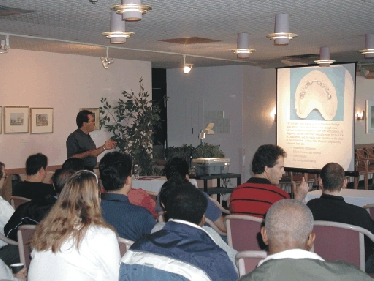 The Denturist Association of Ontario held their annual Perfect Your Practice Conference at the University of Guelph this past June 5th, 6th and 7th, 2003.
Here Peter T. Pontsa, RDT, on behalf of Dent-line of Canada, is presenting his seminar on Precision Attachments for Implant Bars as interested delegates look on.
Dent-Line of Canada was also one of the exhibitors at the conference; many exhibitors showed off the latest in dental materials and techniques.