Dent-Line of Canada Inc. Toll Free 1-800-896-6544 (for Canada only) 416-858-9865 or Fax No. 416-858-9899

Dent-Line of Canada Inc. Toll Free 1-800-896-6544 (for Canada only) 416-858-9865 or Fax No. 416-858-9899
A BULLETIN DEALING WITH ISSUES FOR DENTAL HEALTH PROFESSIONALS
Inside This Issue
1. Bredent’s New Screw System
2. Bredent’s New Precision Attachment
3. Ancient Dental Implant Found
4. Kym Rada, RDT Interviewed on VKS
5. Factors for Attachment Selection
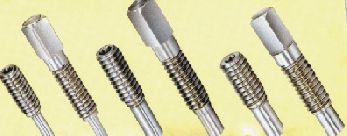
I n April 1997, Bredent, one of the leading German manufacturers launched a new screw for operator- removable restorations which cannot loosen on its own. This screw system has a patented design which prevents micro movements being transferred from the restoration to the screws. Only the head section of this new type of screw is threaded. The section of the screw which protrudes into the inner coping of the bridge is not threaded. Micro movements are absorbed by this non threaded section without loosening the screw. This new design of screw also considerably reduces the risk of fracturing. At the “International Dental Show” in Cologne in April of 1997, Bredent announced that this system was developed specifically for keeping screw retained superstructures on implants. It can be used with virtually all implant systems as well as for all other types of prosthetics. The screws have diameters of 1.0, 1.4 and 1.8 mm, to ensure that the optimum size is always available for the space. Complete sets of instruments and materials are available for processing this new, patented screw system easily and cost effectively. the components of the set can also be purchased separately. Comprehensive instructions are available. For further details contact Dent-Line of Canada at 1-800-859-7589.
Bredent’s Safety Lock Screw System
Available in three sizes: 1.0, 1.4 & 1.8 mm.
For information or your package of litarature please call: 1-800-250-5111 or
e-mail us at dent-line of canada inc.
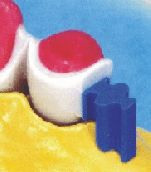 Bredent has succeeded in integrating a shear distributor into a new type of prefabricated attachment. No additional milled in lingual arm is required when using the new “Vario Soft 3 mini SV” precision attachment. This lowers the fabrication costs for combined fixed / removable appliances with ridged, extracoronal attachments considerably. At the same time, the aesthetics are also enchanted noticeably for the patient as the shear distribution arm is not needed. This prefabricated component is only 3.5 mm wide and 4 mm long and includes a patrix and shear distributor. The male attachment is made of burn out resin and is waxed onto and cast in one piece with the wax pattern of the retaining crown. Bredent supplies very precisely fitting females for creating exactly the degree of long-term friction required by the specific patient. the females are available in three degrees of friction; regular, reduced and high friction. Bredent has more than ten years o experience in manufacturing resin/metal precision attachments. For further details contact us at 1-800-250-5111 or e-mail us at [email protected]
Scientists have found what is apparently the earliest known dental implant: a wrought iron tooth in a man who lived about 1,900 years ago in Gaul, or what is now known as France. The discovery was made in the Gallo-Roman cemetery south of Paris. X-rays show a perfect fit in the tooth socket in the upper right jaw. The implant was apparently jammed into place more than a year before the man died, according to a report by French researchers in Nature. Although Ancient Etruscans in northern Italy were known to have made partial dentures, crowns and simple bridges as early as 2,500 years ago, the French finds appears to be the oldest known dental implant. The patient’s original tooth was used as a model and the implant was probably installed soon after the tooth was lost.
Source: Danbury News Times, January 1, 1998.
Mr. Kym Rada, R.D.T. is the owner of Adelaide Ceramics, a high quality dental lab in Ottawa, Ontario. He has been using the Bredent VKS Snap Attachment System for the past six years and we wanted to know why he recommends them.
Q How extensively do you use the VKS attachments?
A. As you are aware, there are five classes of attachments that are in common use. They are the ridged, vertical, hinged, combination and rotational. The Bredent VKS attachments can be used in four of five of these categories. I’ve used attachments for the past 15 years and found that these attachments are the best since they are universal and can be used in varied cases with just one system.
Q How do the VKS attachments fit into your marketing plan?
A. It’s an incredibly good attachment for cosmetics, since you can achieve superior aesthetics. The mini SG for example can be placed lower on the crown closer to the gingiva thus allowing more room for aesthetics.
Q Tell us what you like about them?
A. They are amazingly easy for the technician to use, uncomplicated, you might say. They are also easy for the dentist to use since they have more control chair side. It’s convenient and practical for the dentist to exchange the retention sleeve chair side rather than send the patient to the lab for it.
Q How do you convince your dentist to use the VKS attachments?
A. That’s simple, even if some dentists are subscribing to the attachment of the month. Many over evaluate the complexity of the cases. I tell them the VKS snap attachment is easy to use since you can change them chair side. It makes life simple – it works for me.
Factors for Attachment Selection:
1. Cost.
2. Condition of periodontal support.
3. Condition of residual ridge.
4. Opposing Arch/Vertical dimension.
5. Strength of Bite/Bruxer.
6. The number of abutments.
7. The position of the abutments.
8. Patient dexterity.
9. Limited bucco-lingual space.
10. Limited mesio-distal space.