Dent-Line of Canada Inc. Toll Free 1-800-896-6544 (for Canada only) 416-858-9865 or Fax No. 416-858-9899

Dent-Line of Canada Inc. Toll Free 1-800-896-6544 (for Canada only) 416-858-9865 or Fax No. 416-858-9899
A BULLETIN DEALING WITH ISSUES FOR DENTAL HEALTH PROFESSIONALS
Inside This Issue
1. Researchers Discover Caries Vaccine
2. A Corrective Implant Angulation Technique
3. Featured Product: Bredent’s Silicone Burs
4. Implant Tissue Bar / Bredent’s Vario Soft Bar VSP
5. Neutral Zone Application to Implant Placement
6. Trade News – Whitening Gum, Bee Glue Prevents Tooth Decay
The Forsyth Institute, a research organization focused on oral and craniofacial science is working on developing a vaccine that would administered to children aged 12 to 24 months to prevent tooth decay throughout life. It has discovered a potentiallyimportant antigen that according to the July 2001 issue of Infection and Immunity creates a greater immune response than many previously tested antigens. Using the antigen, the research team led by Martin Tuabman, DDS PhD and Daniel Smith PhD has created a mucosal vaccine that can be squirted into the nose, rather than injected or swallowed. “Despite the great advances in caries research over the past few decades dental decay remains the major infectious disease that effect children” says Dr. Dominick DePaola, CEO of the Institute.” A vaccine for caries would be exciting because it could free tens of millions of children from the ravages of dental disease”. The vaccine has proved effective in pre-clinical trials and the Institute hopes to embark on clinical trials and is seeking support or partners to produce it.
Source: Forsyth Institute, Boston, MA.
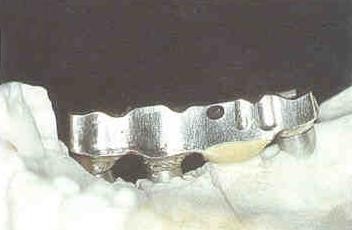 Bredent’s Vario Soft Bar VSS
Bredent’s Vario Soft Bar VSS
“Implants placed without colloboration or treatment planning are a clinical reality that needs a team approach”
Peter T. Pontsa
There are times we encounter patient cases with existing implants that have been placed with out collaboration or treatment planning. In many of these situations little can be done such as in the case of an arch misalignment, like a Class III anatomical relationship. Poor implant angulation due to inadequate bone density or ridge morphology should also be considered. What ever the clinical reality, it will be a challenging and complex project to complete without a team effort. The initial clinical evaluation must be incorporated into the design, fabrication and implant cleansibilty of the prosthetic device. To get predictable results, adequate inter arch space must be maintained, in order for the dental technologist to have optimal thickness of the restorative materials. In this case study we will facilitate rehabilitation of an incomplete over bite and establish corrective angulation of existing mandibular implants with a primary and secondary framework finished with cosmetic porcelain veneering. The case consists of 3 external hexagon implants on 34, 35 and 37. Buccal angulation of theses implants required the establishment of a Class I horizontal relationship. Preliminary impressions were made and custom trays are fabricated in order to fabricate the master models. They are then mounted on the articulator to check the Inter arch distance since the correct buccal-lingual and anterior-posterior space should allow room for the restorative materials before proceeding. The primary framework will utilize plastic (or gold) cylinders that are screw retained The primary infrastructure will be reinforced with a plastic bar pattern (such as the bredent Vario Soft Bar) It will be attached to the lingual side of the plastic cylinders with modeling resin (bredent Pi-Ku-Plast Resin). We finalize all appropriate contours with modeling wax and where necessary milling wax. Next we mount the master model on the milling machine model chuck. Select a 2° wax milling bur and start to cut from right to left at the speed range of 3,000 to 5,000 rpm. Exert only slight pressure and allow the bur to do the work. The rounded tip of the wax bur should stop short of the implant margin so as to create a champer. This can later be blended into the secondary framework, labially and lingually providing a smooth finish line between both frameworks. The primary framework is then sprued and removed thus avoiding deformation of the pattern. After casting and cleaning the framework is ready for refining. Select a 2° profile milling bur (bredent) and starting from left to right, use a speed of 15,000 to 20,000 rpm with slight pressure to refine the surface. In order to achieve steadier running of the milling bur and to prevent rough surfaces, it is absolutely necessary to use milling and drilling oil. This oil produces a uniform lubricating film on the milling surface and extends the life of the bur. The primary substructure is now ready for try-in. At this time any problems with fit can be addressed. If soldering is required ensure that the surfaces are refined with a milling bur. Once the primary structure is polished, we can fabricate the secondary framework. One method we prefer is to use modeling resin to build up the body for strength, then contour with modeling wax and finalize the margin with a good cervical wax. We feel the modeling resin wax combination gives us a good shrinkage model for investing purposes. Casting and refinishing are done to the standards of practice. The ceramic build up can be sent for bisque bake try-in and occlusal adjustments before finishing. In conclusion, this prosthodontic restoration can correct angulated abutments and create functional occlusion while it distributes forces during mastication. It can also improve aesthetics by eliminating the screw tunnels on the occlusal surfaces. The restorations life can be extended by proper contouring. Source: Peter T. Pontsa, RDT
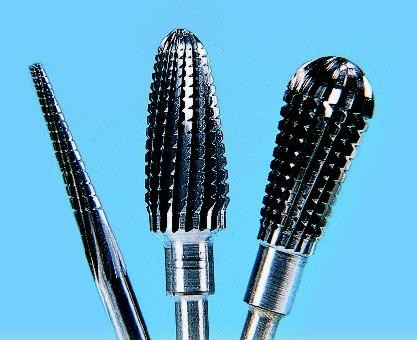 Silicone Burs Unlike conventional soft material burs that are made of steel, the new bredent Silicone Burs are made of Tungsten Carbide. They have three conventional shapes and will last indefinitely. The geometry of the cutting edge is specially designed to be used on both soft and into transitional areas like hard resin materials. Such as blending soft liners into the hard denture acrylic. They are well suited for sports mouth guards, since thermoformed hard and soft plates with different degrees of hardness are rapidly and safely ground. The different shapes can be utilized to cut and shape gingival masks in difficult areas such as in the alveoli of the gingival mask. In orthodontics silicone postioners can be perfectly ground with precision guidance of these tungsten carbide burs. For more information and pricing call us at 1-800-859-7589 or e-mail us at [email protected]
Vario Soft Profile BarEdentulous areas can be restored utilizing implants of various sizes and platforms. There are different modalities like a subperiosteal implant or an implant supporting an over denture, or a tissue bar retaining an over denture supported by the gingival ridge and bar. The Vario Soft Profile Bar from bredent falls in to the later category and has an advantage over other bars because there are three precision retentive clips with different degrees of friction for all bar designs. These indications could be two, four, six or more implants per patient. The bars are fabricated and attached to the implants. using screws. An over denture is fabricated that would include a cast removable framework to house the retentive clips each mated to a VSP bar segment. Ideally four clips can be spread over the bar so as to evenly distribute occlusal forces to all underlying bars and implants. This design allows transfer of the vertical forces of mastication on the working side to the tissue bar and implants while counter balancing retention loss on the opposite side of the denture. During masticatory rotational movements, the retention clips prevent the dentures dislodging while providing vertical support for the prosthetic device. Should there be a problem with ossiointegration, surgical repair of the bone implant interface is simple. The VSP bar can be removed and guided tissue regeneration techniques are used to bury the effected implant. During the healing phase the denture can be worn after which the VSP bar is reattached. Any of the retentive areas can be deactivated for separate repair while other sections are left to function during the healing phase. Dental Hygienist can remove and replace the VSP tissue bars during oral hygiene recalls at which time they can clean plaque and tarter from the bars before polishing them for reattachment. The VSP tissue bar features adjustable friction clips and demonstrates an alternative treatment for distributing forces and torque. Source: Peter T. Pontsa, RDT
“The netural zone uses the patient’s physiology rather than thte natural landmarks” – Dr. Joseph J. Massad.
This is a discussion of the Neutral Zone Technique in Full Dentures and how it relates to placement of implants. Comfort and speech is better with neutral zone dentures over conventional denture methods. The Neutral Zone uses the patient’s physiology rather than the natural land marks. The procedure starts by making a lower base plate. Next mix red and green compound material together and start to melt compound on the base plate about 4mm, then adapt the mixed compound to form a bite rim. It should be placed in a water bath to soften the compound. When it is ready place it in the patients’ mouth. The patient is instructed to drink warm water. When swallowing, the cheek and the tongue will compress the compound to create a matrix for the neutral zone. Repeat the process until the compression stops. Have no contact with the upper teeth. Place the compound base plate on the master model and using silicone putty make a matrix of the labial and lingual. Remove the base plate to expose the mandibular ridge. Using the labial and lingual matrixes you can fabricate a neutral zone stent to help in location and angulation of implants in the neutral zone. Set up bite registration and mount. Use a bar and clip system for the over denture and set up the teeth using a lingualised occlusion. Source: Dr. J .Masad, American Prosthodontic Society 69th Meeting, Feb.26th 1996
Trade News: Chewing gum giant Wrigley and Crest toothpaste maker Proctor & Gamble said they will team up to develop a new line of teeth cleaning smile-whitening chewing gum which could be introduced within the year. Under agreement Wrigley will license various P & G Trademarks and oral care technologies to develop market and distribute gums with oral care benefits the companies said. The glue made by Brazilian Bees could be used to prevent tooth decay. Tests on propolis have shown it can reduce the number of enzymes which help bacteria to latch on to teeth by 70 %. When rats were treated, their cavity rate dropped by 60 % and scientist say they are excited about its potential for humans. It was discovered by Michel Hyun Koo of the University of Rochester. Source: Infodent No.29/01